
Everything you need to know to plan your trip to Ghana
There’s so much to see in Ghana! I wanted to summarize the highlights of my solo trip there with Ashanti African Tours.
Here’s the top seven things you should do while there:
Kente Cloth
Kente cloth is made in Ghana. It is a sturdy fabric and it’s used to make beautiful clothing. While there, I learned that each pattern has a different meaning. It is hard to get the authentic fabric outside of Ghana for a good price, so you’ll want to bring money to buy it while there. It’s cheapest to purchase it in the villages where they make it.
During my trip, I got to see men in the village of Adanwomase weaving Kente cloth and I even got to try weaving it myself. They use ancient wooden machines. It’s a pretty intricate, multi-step process.
Naming Ceremony
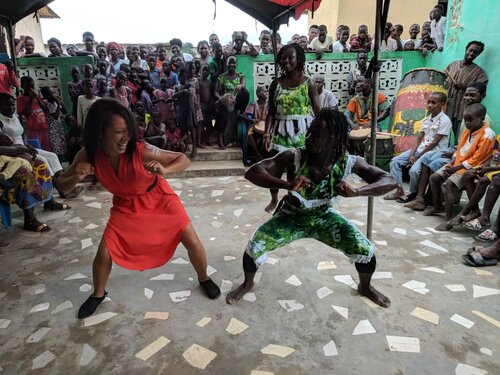
The celebration after my naming ceremony
While there, you’ll want to participate in a naming ceremony, especially if the purpose of your trip is to reconnect with your ancestors who were likely taken from West Africa to the Americas through the Trans-Atlantic Slave Trade.
During my ceremony, the entire village came out to celebrate. There was an entire dance ensemble that performed using drumming and fire. I also had to sit in the home of the chief and watch the elders ask for permission to name me. I found it all quite fascinating. The villagers gave me the Ghanaian Fante name, Nana Aba Ahermah. Nana means royalty. Aba means I was born on a Thursday in Fante. And Ahermah was the name of a famous woman in the village.
I also caught the entire naming ceremony on film, thanks to my tour guides at Ashanti African Tours.
Cape Coast and Elmina Castle

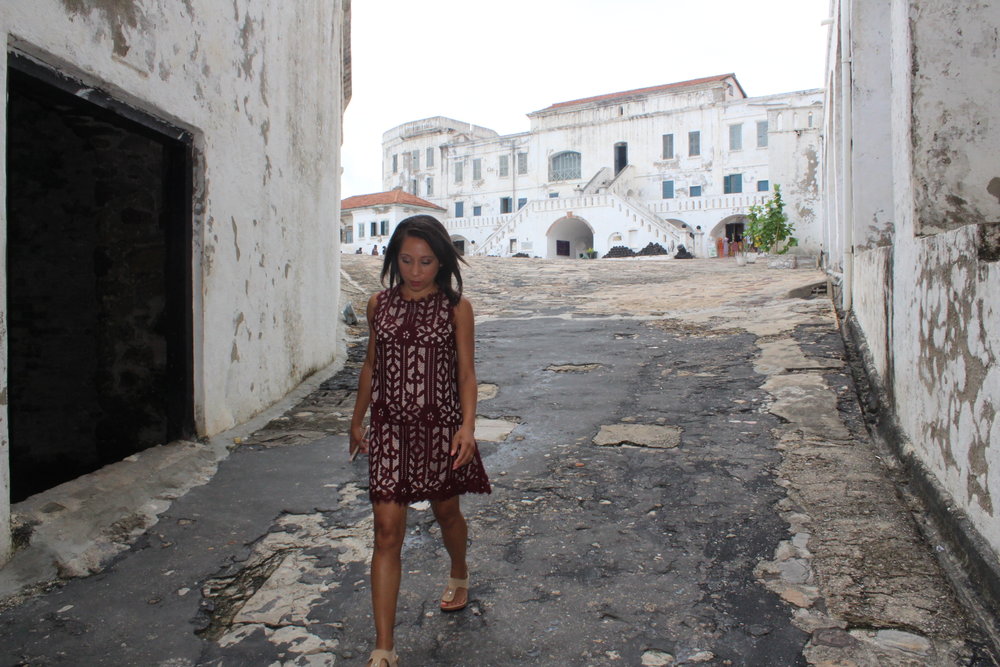
Along the southern coast of Ghana are the slave castles, where Africans were held captive and shipped to the Americas to work as slaves on plantations. Two of the castles that many tourists visit are the Cape Coast Castle and the Elmina Castle. Both are worth visiting. The Cape Coast Castle has an extensive museum which tells the history from the Ghanaian perspective. In both, visitors can walk through the dungeons and just envision how horrible the experience was. Bring your tissues.
I wrote more about my experience here.
Make Adinkra symbols
Have you heard of Sankofa? That’s one of many Adinkra symbols. When you visit the village of Ntonso, you’ll learn about all of the Adinkra symbols. They’re stamped onto clothing, tablecloths, bedspreads and many other things. Each symbol has a message. After learning about the process of making Adinkra cloth and the symbols, you’ll then get to make your own stole.
Watch this video to learn more about the symbols and see how the cloth is made.
Have clothes made
The clothing is so beautiful in Ghana. And you can get dresses made for less than $100, fit to your body that will last a lifetime.
You’ll want to find a seamstress right after you arrive and bring them the cloth that you want used for your clothing. That way the clothes will be done by the time your vacation is over. They can make dresses, shirts, you name it.
I bought my cloth at Woodin, one of the upscale stores that sells it. But you can also go to the market and buy some and it’ll probably be less expensive.
We found our seamstress in Osu, one of the neighborhoods in Accra. But there are seamstresses everywhere in Ghana, working in little houses alongside the road. It typically takes them five to seven days to make an outfit. Try them on before you take them home to make sure they fit good. They’re able to make small adjustments on the spot. I can’t wait to go back and get more clothes custom made.
Visit the Ashanti Kingdom
If you’re traveling across the globe to Ghana, you’ve got to check out Kumasi, home to the Ashanti Kingdom. The Kingdom has ruled the area for centuries and it has a rich and fascinating history.
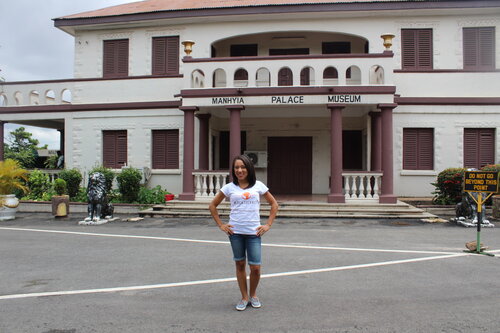
The Manhyia Palace is the hub of the Ashanti, the Kingdom of gold. It’s where their King conducts business. There’s a museum on the property dedicated to the Kingdom’s history. There you will learn about the Kings and Queens of the past and present, their role in global diplomacy, and how to act around them. This place was fascinating and the tour guides are great. FYI- they don’t allow you to film or take pics inside.
Shop at the markets

While you’re in Kumasi, head over to the Kejetia market. It is known as the largest in West Africa. There’s more than 10,000 stores/stalls there. It’s a great place to witness daily life in Ghana. And you can find just about anything you are looking for.
There’s also an awesome craft market near the Aburi Botanical Gardens, which is outside of Accra. There, you’ll see artists carving wooden masks. There’s lots of great drums and artwork there for sell too.
Getting there
From United States, there are direct flights from New York City (JFK) and Washington DC (IAD). It’s a ten hour flight. In Europe, there are direct flights from Amsterdam, Lisbon, London, Paris, Brussels, and Istanbul. There are also direct flights from Casablanca, Beirut, Cairo, Doha, Dubai, Freetown, Monrovia, Abidjan, Lagos, Freetown, Addis Ababa, Nairoi, Johannesburg, and Kigali. Most international flights arrive in the capital, Accra. From there, you can take buses or flights around the country or hire private transport. There’s also Uber in Accra.
To get into the country, you must have proof of Yellow Fever vaccination and a tourist visa. All non-citizens or residents 18 years old or older must also be fully vaccinated in order to enter the country.
Lodging
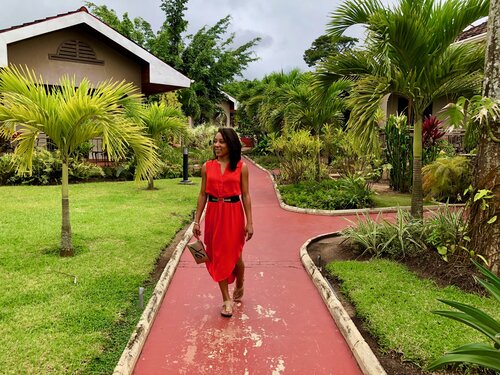
While I was there, I stayed in hotels in Kumasi, Accra, and Cape Coast. Overall, I found the lodging to be nice. When booking a hotel, I would book one that has a restaurant attached to it that serves breakfast and dinner. Also, read the reviews about its wifi because you’ll definitely want one with good WiFi.
What you Need
When traveling to Ghana, bring hand sanitizer, a plug adapter, mosquito repellant, malaria pills, and lots of cash. Masks are not mandated but the CDC recommends wearing them in indoor places. It’s a mostly cash economy and a lot of places do not accept credit cards. They have ATMs if you run out.